Monday, March 14, 2022

Since I moved to Kandanga in Dec 2020, 30 minutes from Gympie in Qld I have been writing a story for each month's Gympie Living

Here is my first story starting in March 2021:

Book Review: The Carbon Club by Marian Wilkinson, Allen & Unwin

HOW AUSTRALIA BECAME AN INTERNATIONAL PARIAH ON CLIMATE CHANGE. By Jim Beatson

Marian Wilkinson’s new book explains how huge oil and coal interests in the United States and Australia cooperated for over 20 years to prevent successive Australian Governments effective action on climate change. Today these interests hold majority control of the federal Liberal and National parties. How? By influencing in candidate pre-selection contests, funding and organising support for hard right candidates, including social media postings, all supported by Murdoch’s media commentators.

Investigative Journalist, Marian Wilkinson, is a giant of Australian journalism. She won two Walkley Awards for her work as reporter and producer of ABC's Four Corners program. Her meteoric rise started as reporter for community radio 4ZZZ, Brisbane, leading to New York and Washington correspondent for both ABC and Fairfax newspapers. In 2018, she was inducted into the Australia’s Media Hall of Fame.

The Carbon Club started years ago as a UK-funded TV documentary. Then Wilkinson was told by the film company, “Kevin Rudd's been elected…that's all dead now, you've got big climate action in Australia. Well, of course, you know, 13 years later, we're still waiting. And when I left Four Corners at the beginning of 2018, a lot of people were pressing me to write a book, and I was equally determined.”

The book works through the obvious villains: Abbott, Murdoch, Morrison, media shock jocks and social media. But Wilkinson introduces equally important but obscure players like Hugh Morgan, the principle owner of Western Mining, and Sen. Cory Bernardi.

“Hugh Morgan,’ Wilkinson writes “is a fascinating character, his real power came through the [dominant] Victorian state branch of the Liberal Party… and that power then emanated out from there [with Morgan] Chairman of its cash cow, the Cormack Foundation, … one of the most important funders of the Liberal party federally and of its Victorian and Western Australian divisions."

“[Morgan] would later say “ deep connections between the Australian and US climate-sceptic movements created the deluge of emails and calls had swung the vote [for Tony Abbott] against Turnbull...This was the first time in Australian political history that a political leader has been deposed by the rank and file of the party."

Wilkinson describes the rise Cory Bernardi. “He got his place in the Senate thanks to his mentor, Nick Minchin...he became a vocal defender of Australia's climate sceptics. Morgan's factotum was Ray Evans, still Australia's most influential campaigner against climate science...”

Impressed by Evans and Morgan’s apparent effectiveness, Bernardi left a position in Prime Minister Howard's office, moved to the US in 2008 and “met with a whole range of different organisations over there, the activist organisations in the tax space, in the freedom space, in the smaller government space, in leadership development. I kind of became their go-to person in Australia”.

Bernardi signed up for a training course with the Leadership Institute in Virginia where he learnt about using what he described as "voter databases and online technology to mobilise grassroots campaign...These tools would prove vital in the fight to block Labor’s climate change policy."

Bernardi watched the billionaire fossil fuel barons, the Koch brothers and their billionaire allies, poured hundreds of millions of dollars into countless Political Action Committees and lobbyists. They finally took over the Republican Party, its membership, and through preselection contests, determine Republican candidates in state and federal elections.

On returning to Australia, Bernardi’s influence on Minchin, and later Andrew Robb, made opposition to action on climate change a defining Coalition policy.

Wilkinson equally examines all the compromises and divisions between Labor and the Greens over climate change policy options. She presents a brilliant forensic examination of the dysfunctionality of Australia's federal political system.

For anyone interested in the backstory of Australian government processes, Marian Wilkinson’s analysis is a must read (including 101 pages of Chapter Notes)

Marian Wilkinson is speaking about her book and joining a Q & A at the Maleny Community Centre, 23 Maple Street, Maleny on Thursday 8 April 2021 at 6:00 PM to 8:00 PM. Event organised by www.outspokenmaleny.com. Book tickets online fast.

- ends


Thursday, March 3, 2022

From the period August 2020 until December 2021 I resumed being a Radio Journalist at my local radio station, Bay FM, Byron Bay, (where you will find my stories appearing in the Community Newsroom section of http://programs.bayfm.org/community-newsroom) serving New South Wales Northern Rivers region, and still contributing the odd story the The Byron Echo.

In December 2021 I moved to Kandanga, just 20ks south of Gympie in Queensland and commenced writing for Gympie Living, a local monthly magazine where I cover major political issues at a local, state or national level.

Friday, July 17, 2020

Echonetdaily 17 July 2020

https://www.echo.net.au/2020/07/are-byron-visitors-following-covid-19-safe-practices/

Are Byron visitors following COVID-19 safe practices?

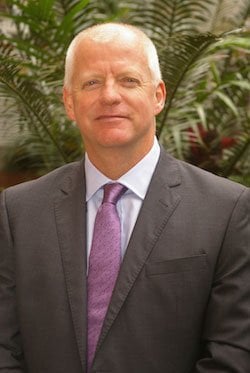
Chief executive of Northern NSW Local Health District Wayne Jones.

Jim Beatson

The identification of a new case of COVID-19 arriving at Ballina airport earlier in the week has reminded everyone in the Northern Rivers that there is still a need to practice social distancing, hand washing and begs the question should we all be wearing masks?
‘There is no need for greater effort from medical institutions like Byron Hospital or the Northern NSW Local Health District to issue a statement regarding the need for social distancing and the wearing of masks given Byron Bay’s many visitors,’ says Wayne Jones, the Chief Executive Officer for Northern NSW Local Health District.
Mr Jones explained that ‘There have been COVID cases previously in Byron Shire but, all bar one, has recovered and the latest one is in the postcode 2480 which excludes Byron Shire (It mainly consists of East Lismore, but does include Federal, Rosebank, Booyong, Dunoon, Corndale and Clunes)’.
When asked why so few people in public places in Byron Bay are not wearing masks Wayne Jones initially deflected the question saying, ‘I think it’s up to individuals to decide whether to wear a mask. There is no real evidence that compulsory mandated wearing of masks has a huge benefit.’
However, mask wearing is part of a comprehensive strategy to avoid COVID-19 transmission when social distancing is not possible or you are in an area where there is high community transmission. Currently mask wearing is being recommended in Victoria for people who are leaving the house who are living in an area with stage three restrictions.
When pressed Mr Jones added, ‘In saying that, I’m certainly not against it and if people feel more comfortable wearing a mask and we certainly are seeing an uplift in people wearing masks in our communities. So I strongly recommend any strategy that reduces the risk of COVID coming into our community, including the wearing of masks.
‘We are pushing very hard, reminding people of all of those strategies, physical distancing, and where appropriate, hand and respiratory hygiene. And we will continue to do so. With the latest case that’s been identified in our patch we will reinvigorate our campaign.
‘Now is not the time to be complacent. COVID is going to be here for an extended period of time. So just accept that physical distancing and hand and respiratory hygiene are here to stay.
‘But I want to emphasise the vast majority of people on the North Coast are doing the right thing.’

Friday, December 15, 2017

Echonetdaily 14 December 2017

Island Quarry death inquest winds up amid complaints

The Island Quarry near Byron Bay.
By Jim Beatson
The inquest into the death of 20-year- old Melbourne man, Brendan Vickery, ended yesterday with a number of unresolved disputes, and complaints of delays raised by the deceased’s family and their legal counsel.
Seven are ofcritical importance.
First, the family legal counsel queried the tardiness of Island Quarry Reserve Trust to take precautionary measures such as fencing and signage.
In November 2011 by Dr Robert Davies, network director for emergency departments at four hospital sites across the Northern Rivers reported nine serious injuries including six spinal fractures, at least four were multiple
fractures.
Some two and half years passed before the 1.8 m safety fence was constructed along the Ewingsdale Road side of the dangerous quarry site. This was completed just three weeks after Brendan Vickery’s death.
The Island Quarry Reserve Trust’s Barrister, Mr Raeburn, insisted that the delay was outside the control of the IQ Quarry Trust President, Shane Rennie.
A discussion about the lack of more safety signage was left incomplete.
Medical staff mentioned an important deterrent: signs explicitly listing known injuries that occurred at the site.
A counter argument was put by several interviewees that such signs would instead be seen as an exciting challenge by young people visiting the site.
Supervision of the site was revealed to be irregular. Baz Laow, a self-described “WOOFA”, was given the role by Shane Rennie. Laow did not live at the site and was there only on average two days a week (Wednesdays and Thursdays).
He was not there on weekends, when the numbers of visitors in Byron Bay are often high.
The cause of death remains unverified. The pathologist, Dr Brian Beer performed the external examination on the body and said he based his decision, of “death by drowning on the balance of probability”.
Barrister David Evenden, representing Brendan Vickery’s parents, challenged this pathology report, saying without a full autopsy, medical experience alone would suggest possible additional causes.
Despite a request by Brendan’s mother, Tracie McDew, for a full autopsy, her request was never passed on beyond the police officer in charge of the investigation. Such requests are normally respected.
The Coroner, Teresa O’Sullivan, Acting State Coroner will deliver her report at the Glebe Coroner’s Court in Sydney on 11 April 2018.

Wednesday, December 13, 2017

Update on where I am working now

I have resigned as the Executive Producer of a weekly one-hour current affairs program, the Community Newsroom, at Bay FM, Byron Bay, which broadcasts on Fridays on 99.9 MHz frequency between 11 AM and 12 noon where I was one of its founders and reporters on commencement of the program in 2016.
It is with pleasure to note that Mia Armatage is the new EP, one of several talented women and men working for the Community Newsroom.
I still typically do one story a week plus a weekly critical weekly round up of things happening across Australia, but mainly in the Northern Rivers region of New South Wales, called the Byron Buzz.You will find all of our podcasts, each with the name of that journalist's stories, at: programs.bayfm.org/community-newsroom/ or https://soundcloud.com/bayfm or at Facebook: community newsroom byron bay
I still mentor new trainee journalist and still write the odd story for our excellent local newspaper, the Byron Echo and Fairfax' newspapers.

Echnetdaily 12 December 2017 on Coronial Inquest in a death at Byron Bay's IQ Quarry

Coronial inquest hears of multiple injuries at quarry death site

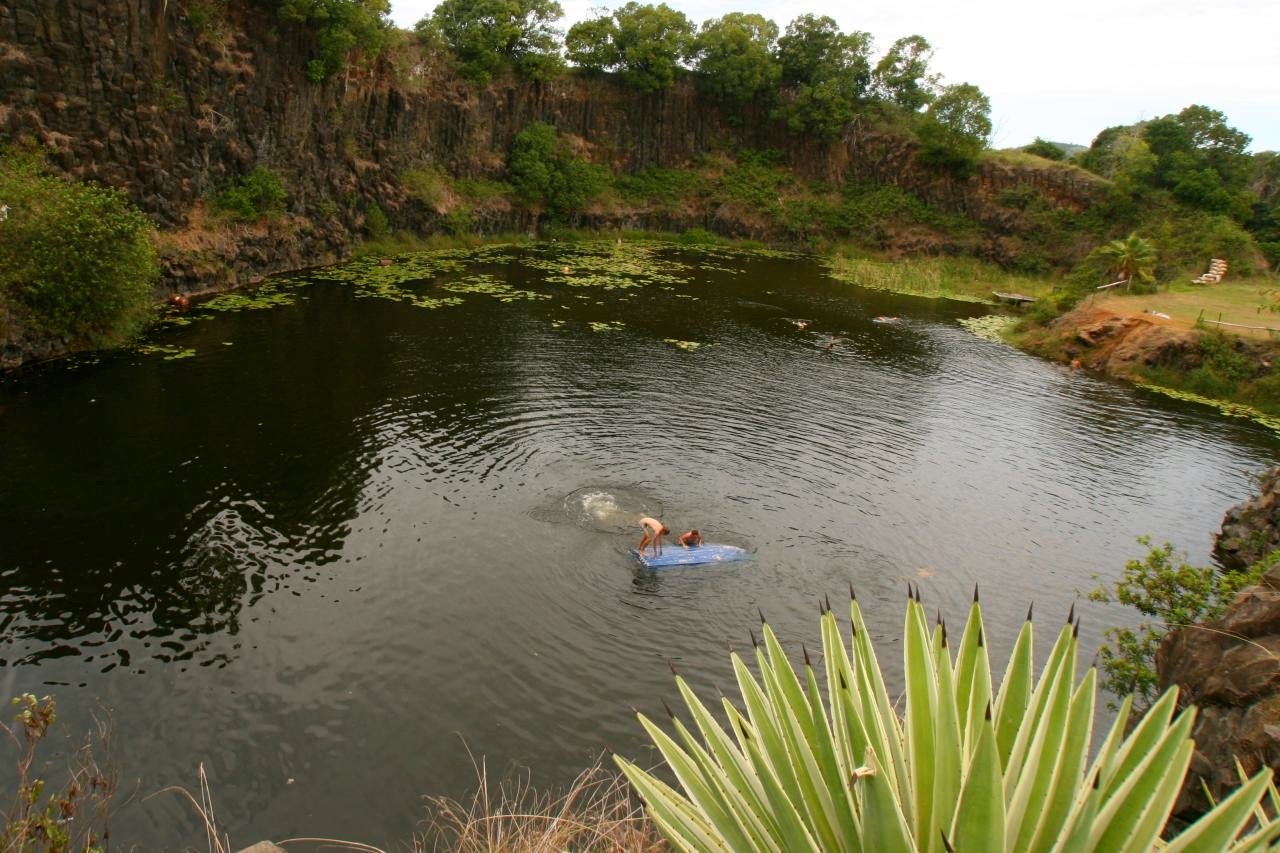
The Island Quarry at Byron Bay where Brendan Vickery died in February 2014 after jumping from a cliff into the water. Photo rodc/flickr.com
Jim Beatson
Dark details and important lessons emerged on day one of the coronial inquest at Byron Bay Court into the death of 20-year-old Brendan Vickery.
He died on February 23, 2014, at the astonishingly beautiful, but dangerous Island Quarry, opposite the Cavanbah Centre on Ewingsdale Road.
The main feature at the quarry is a large waterhole. Brendan’s body was found under that water by police.
On Monday (December 11) the first witness was Luke Johnston.
He said that he was friends with Brendan, Rex, Drew and Elliott, some of whom had driven up from Sydney the day before.
‘We went to bed around 9.30 or 10pm on the Saturday,’ Mr Johnston said.
After a cruisy Sunday morning, starting at 8.30am, the friends arrived at the quarry in the early afternoon.
At its centre is a waterhole, a quarter of which is covered in lotus blossoms and lily pads. One side has a high cliff and the other a grassy flatland just above water-level.
Mr Johnston said there were no signs against trespassing at the entrance of the quarry. Just a sign saying, ‘You Are Here At Your Own Risk.’
Mr Johnston told the hearing ‘I’d heard that people had broken their back there previously, but it didn’t worry me. Drew may have told me. The only thing that might have worried me was the height [of the cliff].’
Mr Johnston also explained there were no notices providing people with a list of the many serious injuries that had taken place there.
In 2012, Swedish backpacker Emma Weisglas, then aged 20, smashed her vertebrae when she hit the water at speed.
In the previous year, 15-year-old Jack Pollock and a 21-year-old American backpacker were so severely injured they were almost paralysed while ‘tombstoning’ at the same location.
Dr Robert Davies, network director for emergency departments at four hospital sites across the Northern Rivers told the inquest there had been ‘many cases over several years with spinal fractures and near drownings.’
He explained there had been ‘ten notified hospital injuries with six being fractures of the spine. A majority having multiple fractures.’
Confronted with this information, Mr Johnston explained ‘It’s an adrenaline thing to do it [jump]. It was a surprise to hear a history of injuries…Had I known this it may have deterred me.’
Mr Johnston was an experienced cliff jumper since jumping in a rock quarry waterhole in Melbourne. ‘Where’s there’s no oxygen in the water, no buoyancy (sic). You have to tread water to keep afloat’.
At the top of the overhanging cliff, a dozen meters or more above the level of the water,Mr Johnston saw a sign saying ‘something about unstable rock’. WhileMr Johnston did jump from there, he told the inquest he dropped a stone into the water first, to break the water’s surface tension.
Mr Johnston said Brendan didn’t jump but looked at another much lower ledge only 3 to 5 metres above the water level.Mr Johnston explained, ‘we were both good swimmers, but [Brendan] was uncertain about jumping’ ‘He was not a fitness junkie’ ‘There was no pressure on him to jump other than “you can do it mate”.’

How it happened

From yesterday’s evidence, the friends were often at separate locations at the waterhole.Mr Johnston said ‘I didn’t hear him jump [from the high cliff]. I think [he must have] banged his head because his foot slipped [from jumping from the lower ledge].’ Asked if he would have called out if he had been in trouble, Mr Johnston agreed ‘[Brendan] would have sung out if he felt he was in trouble’.
Later one of the group noted Brendan called out he was ‘pretty puffed’ (sic)’. But no one noticed Brendan’s disappearance for what then appears to be around 20 minutes. When group noticed his absence, Luke went to top of the cliff to look down from above and checked to see if he was in the car. After ‘30 to 40 minutes we rang the police.’
Later the police found Brendan’s body. At yesterday’s hearing no explanation was provided as to why an autopsy was not conducted. Dr Davies noted there was ‘always danger with still water.’
‘There may have been a pre-existing condition, also he could have had an adrenaline rush from the situation. In medicine anything is possible.’
Dr Davies added ‘We suspect many injuries are not reported especially by overseas visitors’.
He described a case of an overseas visitor who didn’t report a burst lung which happened at the site until the following day.
More importantly he said it was ‘quite frustrating that we were trying to get a message out about the pattern of injuries there, but there was no good system in place.’
The quarry is sited on Crown Land, leased to Byron Shire Council, who in turn lease it to the Island Quarry Reserve Trust. ‘Neither Crown Lands nor Byron Shire Council saw it as their problem. Their actions did not match the severity of the situation.’ The doctor also noted social media actively promoted the little-known dangerous waterhole.
Dr Davies said in November 2011, his predecessor ‘Dr Winston McKean, had approached [the president of] the Island Quarry Reserve Trust, Shane Rennie, regarding the ongoing pattern serious accidents and proposed filling in the waterhole.’
The inquest was adjourned at just after 4 PM.
On Tuesday morning, Mr Rennie and others are expected to take the stand. The inquest may conclude by Wednesday afternoon. The lessons may take longer to learn.